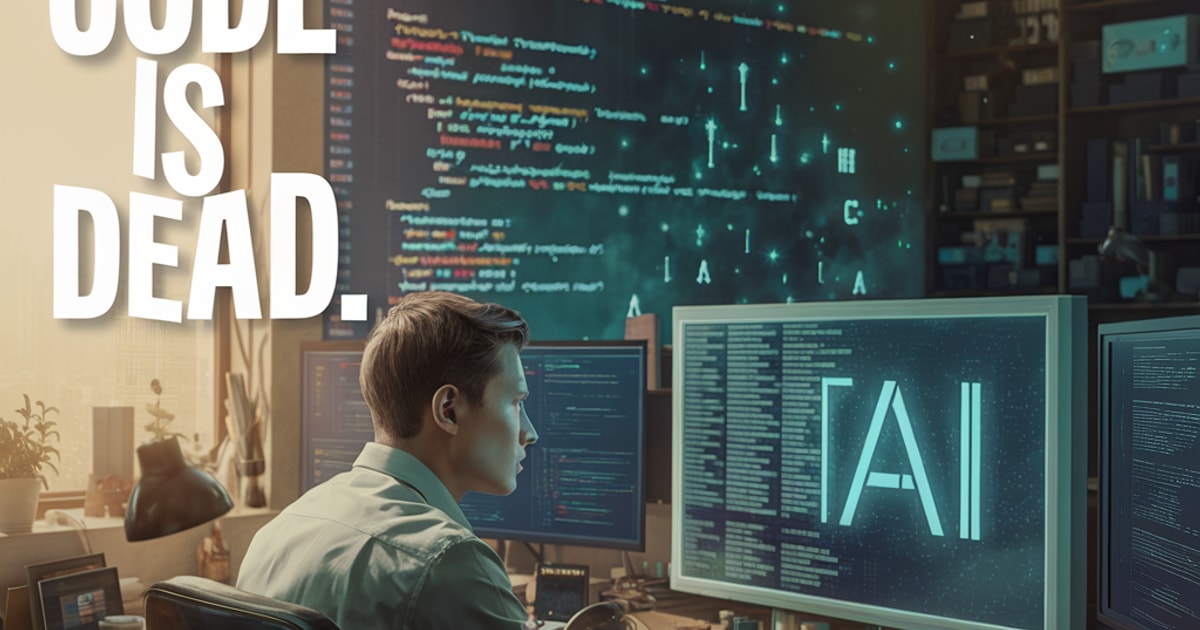
Coding Won't Save Your Job Anymore: What AI Tools Mean for Tech Careers
For fifteen years, "learn to code" was the default career advice. Lost your job? Learn to code. Want to future-proof your income? Learn to code. Looking for remote work? Learn to code.
Sam Altman just told a room full of Indian tech workers that advice is over.
Speaking in India this week, the OpenAI CEO was blunt: "The obvious tactical thing is just get really good at using AI tools." Not learning syntax. Not mastering frameworks. Using AI tools.
This isn't coming from a random influencer. This is from the person building the technology that's rewriting the rules.
The Numbers Don't Lie
AI already writes 50% of code in many organizations. Microsoft's India president put it even more directly: "AI will unbundle operational tasks that don't add real value."
Translation: If your job is translating requirements into syntax, you're in the automation zone.
When Altman graduated, learning to code was the obvious move. Now? "AI tools are the new equivalent," he said.
What This Actually Means for You
If you're a software engineer reading this and feeling defensive, take a breath. This isn't "developers are obsolete." It's "the skill that matters is changing."
The developers who will thrive aren't the ones who can write the most elegant loops. They're the ones who can:
Use AI to ship faster. A solo developer with Claude or GitHub Copilot can build what used to take a team. The bottleneck isn't writing code anymore. It's knowing what to build and how to architect it.
Focus on problems, not syntax. When AI handles implementation details, the valuable skill becomes understanding business logic, user needs, and system design. The "why" and "what" matter more than the "how."
Orchestrate, don't type. Think conductor, not pianist. Your job is guiding AI tools, reviewing output, catching edge cases, and making architectural decisions. The typing part? That's automated.
For Everyone Else: The Window Just Opened
Here's the part that matters if you're not a developer.
For years, you've had ideas you couldn't execute. "I wish I could build an app for [problem], but I don't know how to code."
That barrier just collapsed.
Tools like Cursor, Claude Code, Lovable, and Bolt.new let you build functional software through conversation. Describe what you want. Iterate in plain English. Deploy real products.
Marketing managers are building custom analytics dashboards. Operations people are automating workflows with internal tools. Founders are shipping MVPs without hiring developers.
This isn't "no-code" where you're dragging boxes around. This is conversational software development. You still need to understand what you're building and why. But the technical barrier is gone.
The Shift That's Already Happening
Microsoft, Google, and Anthropic are all racing to embed AI coding tools into every developer workflow. Not as a nice-to-have. As the default.
GitHub Copilot has 1.8 million paying users. Cursor raised $100M in funding. Claude Code is shipping features weekly. These tools aren't experiments anymore. They're infrastructure.
And the people using them aren't all developers. They're product managers who got tired of waiting. Marketers who needed something custom. Founders who couldn't afford a dev team.
What to Do Right Now
If you code for a living: Get fluent with AI tools immediately. Not "try them out." Master them. Learn to prompt effectively, review AI-generated code quickly, and architect systems that AI can help implement. Your value is shifting from implementation to judgment.
If you don't code but want to build: Pick one AI coding tool (Claude Code is free to start) and build something small this week. A simple calculator. A to-do list. A form that emails you. Prove to yourself that you can.
If you manage technical teams: Stop measuring productivity by lines of code written. Start measuring by problems solved and features shipped. The teams using AI well will 10x the ones who aren't.
The Uncomfortable Truth
This isn't a theoretical shift coming in five years. It's happening right now.
Every week, someone posts on Reddit about building a profitable micro-SaaS with AI tools and zero coding background. Every week, another company announces they're shipping faster with smaller teams because of AI.
The people who win won't be the ones who can write the best code. They'll be the ones who can use AI tools to ship the best solutions.
Altman graduated when coding was the safe career move. Now it's the baseline that AI is automating.
The question isn't whether this is fair. It's whether you're ready to adapt.
Try It Yourself
Open Claude or ChatGPT right now. Type: "Help me build a simple web app that [does something you actually need]." Follow the instructions. See how far you get in 30 minutes.
You might be surprised how much you can build without writing a single line of code yourself.
The barrier isn't technical anymore. It's believing you can do it.
Sources:
- Economic Times coverage of Sam Altman India speech (March 2026)
- Microsoft India president on AI automation
- OpenAI developer metrics
Share this article